Why Visual Notes Work: The Science
50 years of cognitive research shows visual notes aren't just prettier — they're scientifically proven to improve memory and comprehension.
The Two-Channel Theory
Dual Coding Theory (Paivio, 1971)
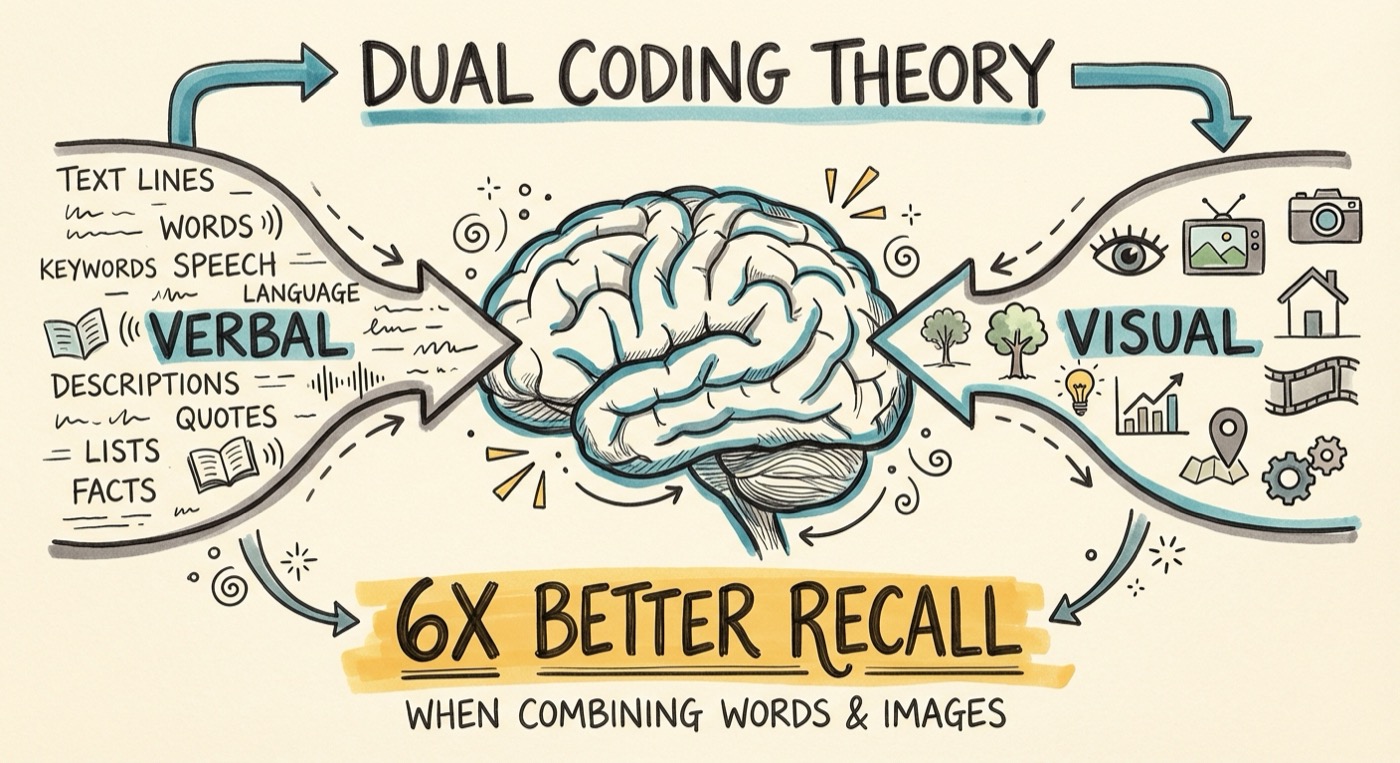
Your brain processes information through two independent channels: verbal (words, text) and visual (images, spatial relationships).
When information is encoded through both channels simultaneously, it creates multiple retrieval pathways in your memory, making recall significantly easier.
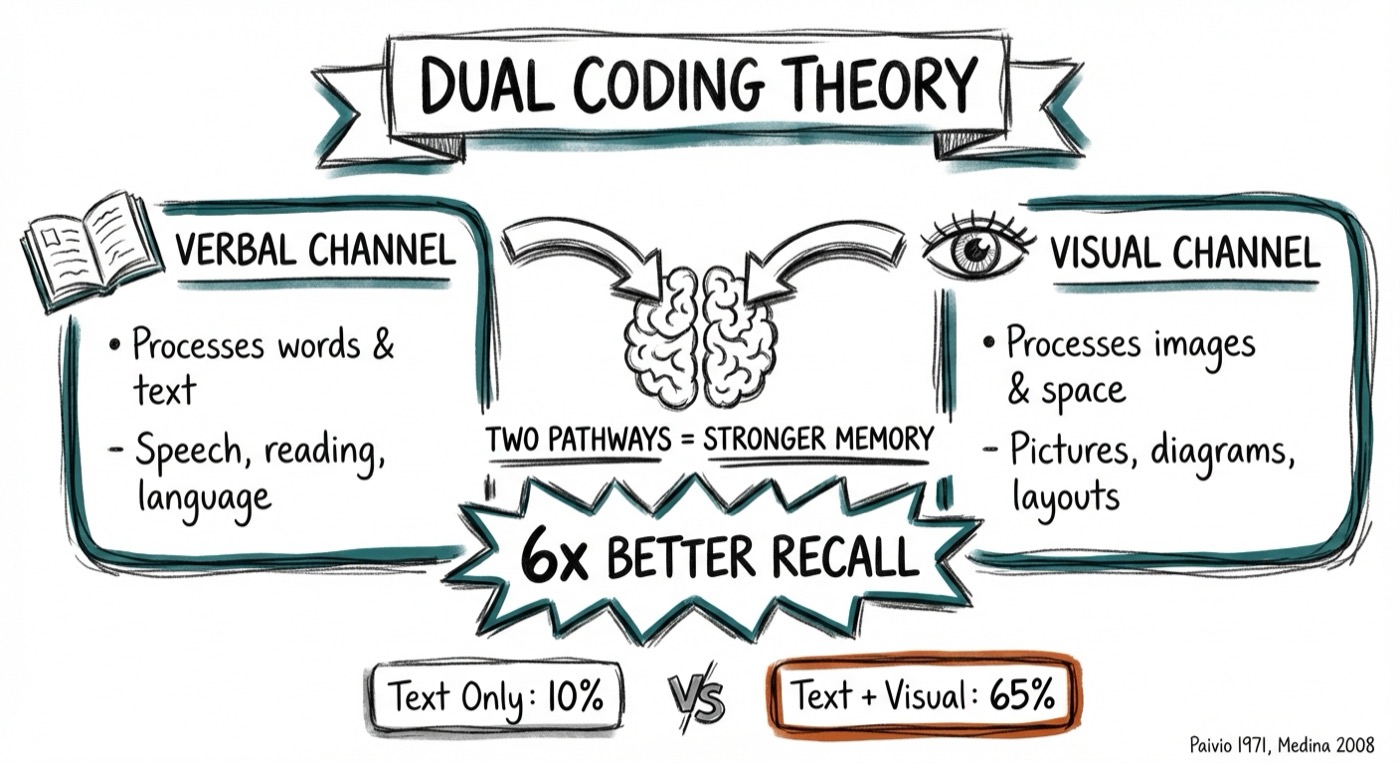
Information presented both verbally and visually is recalled 6x better than information presented only verbally.
— Medina, J. (2008). Brain Rules: 12 Principles for Surviving and Thriving at Work, Home, and School
Text-only meeting summaries use one channel. Sketchnotes use both. That's not a stylistic choice—it's a cognitive advantage.
The Drawing Effect
Why Creating Visuals Matters (Wammes et al., 2016)
The act of converting verbal information into visual form forces deeper processing.
Participants who drew concepts during learning retained 45% of information after 7 days, compared to 20% for those who only wrote notes.
SketchScript's Advantage
You get the cognitive benefits of "drawing" without the time cost. AI does the visual encoding for you—turning a 30-minute manual process into 2 minutes of automated generation.
Neurodiversity Benefits
Cognitive Load Theory (Mayer, Sweller)
Visual redundancy (presenting the same information both verbally and visually) reduces cognitive load, making information more accessible.
ADHD
Visual cues help sustain attention and chunk information into manageable pieces. Research shows individuals with ADHD experience lower cognitive load with redundant visual information than with text alone.
PMC systematic review (2024)
Dyslexia
Dual coding provides an alternative access pathway when text decoding is difficult. Visual structure reduces the reading burden while preserving information comprehension.
Autism Spectrum
Visual structure makes implicit relationships explicit, reducing ambiguity. Spatial organization helps process information that might be overwhelming in linear text form.
What Makes Sketchnotes Effective
Organic Structure vs. Templates
❌ Template Diagrams
- Rigid grids
- Uniform spacing
- Predictable flow
- Computer-generated feel
✓ Authentic Sketchnotes
- Organic layouts
- Varying emphasis
- Visual metaphors
- Hand-drawn aesthetic
Why it matters: Your brain is better at remembering distinctive, irregular layouts than uniform grids. This is called the Von Restorff effect—unique items in a set are recalled more easily than uniform items.
Hand-drawn aesthetics also reduce cognitive load by feeling approachable and human, not intimidating and algorithmic.
Citations & Further Reading
Primary Research
- Paivio, A. (1971). Imagery and Verbal Processes. Holt, Rinehart and Winston. Foundational dual coding theory
- Medina, J. (2008). Brain Rules: 12 Principles for Surviving and Thriving at Work, Home, and School. Pear Press. 10% vs 65% recall statistics
- Wammes, J. D., Meade, M. E., & Fernandes, M. A. (2016). "The drawing effect: Evidence for reliable and robust memory benefits in free recall." Quarterly Journal of Experimental Psychology, 69(9), 1752-1776. Drawing vs. writing recall: 45% vs 20%
- Mayer, R. E. (2009). Multimedia Learning (2nd ed.). Cambridge University Press. Cognitive load and visual redundancy principles
- PMC (2024). "Visual redundancy and cognitive load in ADHD students: A systematic review." Neurodiversity benefits of dual encoding
Why We Avoid "Learning Styles"
The popular "visual/auditory/kinesthetic learner" theory has been debunked by research. People don't have fixed learning styles—they have preferences that vary by context and task.
Dual coding theory is different: It's about universal memory architecture, not individual preferences. Everyone has both verbal and visual processing channels. Using both is better than using just one—for everyone.
This isn't about catering to "visual learners." It's about working with how human memory actually functions.
Ready to Try Science-Backed Notes?
3 free sketchnotes backed by 50 years of cognitive research. No credit card required.
Start Free